The Follow-the-Sun Support Model: How to Ensure True 24/7 Coverage (Without Handover Risk)
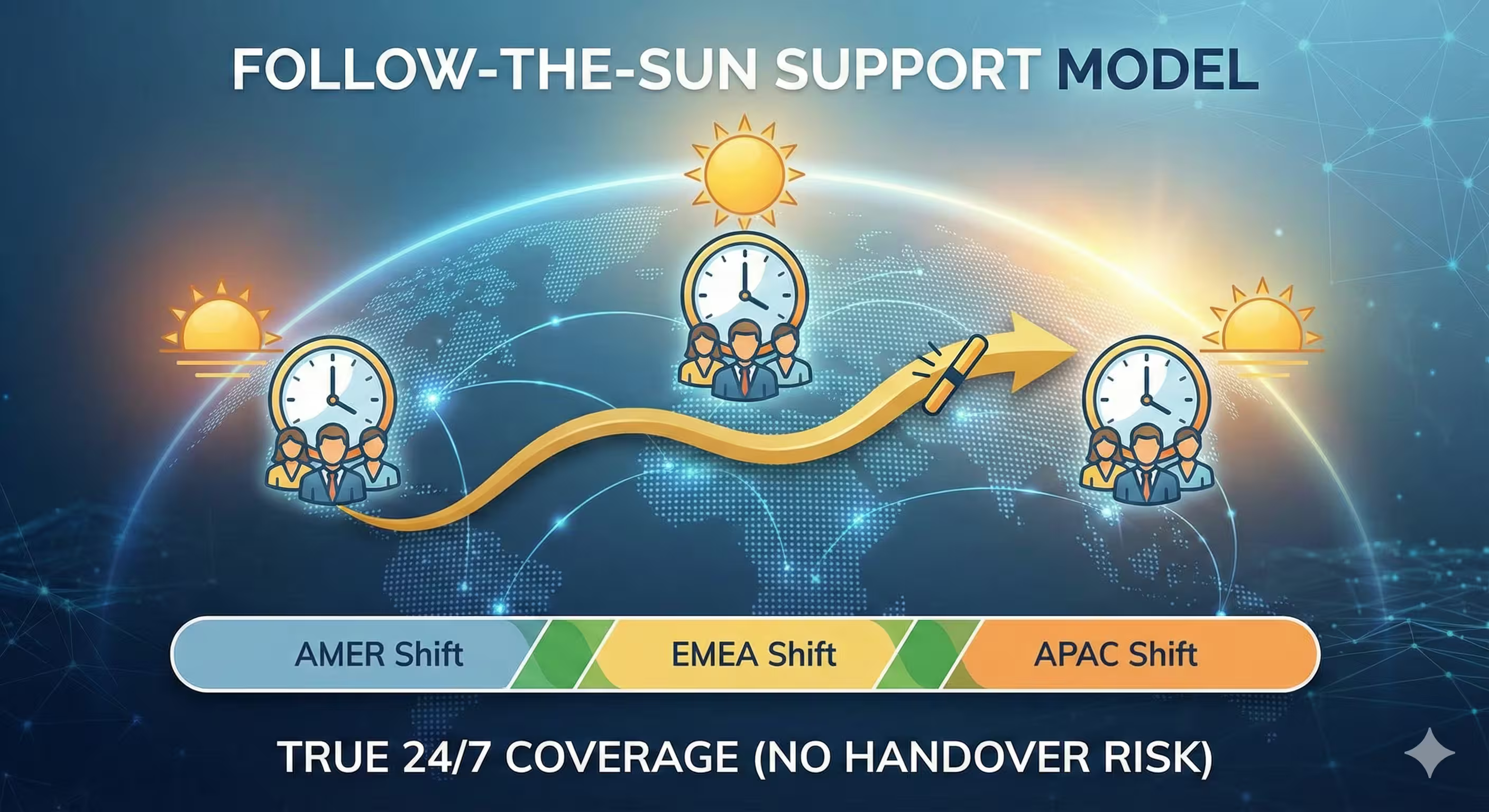
The follow-the-sun model can deliver 24/7 support without night shifts, but only if handovers, overlap time, and queue ownership are designed properly.
Key takeaways
- Follow-the-sun works when coverage is designed around customer demand, not just office locations.
- Most failures happen at handoff points where overlap, ownership, and escalation rules are weak.
- A shared UTC coverage view makes gaps and skill mismatches easier to spot before they hurt service.
- Forecasting and intraday management are essential if global coverage needs to stay resilient during the day.
A follow-the-sun support model promises 24/7 coverage without asking one local team to absorb every night, weekend, and holiday shift. That promise is real, but only if the handoff between regions is designed with as much care as the staffing itself.
Most failed follow-the-sun programs do not fail because the map is wrong. They fail because ownership, overlap, escalation rules, and visibility are weak at the exact moments when work moves from one team to another.
This guide lays out how to design a follow-the-sun model that feels continuous to the customer and workable for the teams running it.
What follow-the-sun actually means
Follow-the-sun means work moves across regions so each team handles demand during local daytime hours. Instead of building a single-site operation around overnight labor, you distribute coverage across time zones.
That makes the model attractive for global support, trust and safety, managed services, and any operation where customers need fast help around the clock.
- Good follow-the-sun design creates continuity without relying on overnight heroics.
- Bad follow-the-sun design creates invisible gaps, duplicate work, and handover confusion at region boundaries.
Why many 24/7 support setups still fail
Coverage on paper is not the same as coverage in practice. Teams often prove that every hour has "someone online," but they do not prove that the right queue, skills, and decision rights are available when a case crosses a handoff window.
- handover notes are inconsistent or too long to use under pressure
- the incoming team inherits tickets without clear priority, owner, or next action
- there is no planned overlap, so transfer happens exactly when one team logs off
- escalation paths differ by region, which creates uneven customer experience
- leaders can see shifts, but not live coverage risk across the day
Design the model from customer demand, not office locations
The first question is not "Where do we already have people?" It is "When do customers need coverage, and what kind of response do they need at those times?"
That sounds obvious, but many follow-the-sun models are just legacy teams stitched together. A resilient model starts with demand windows, backlog sensitivity, queue types, and escalation urgency.
1. Define the operating windows that matter
- separate always-on queues from queues that can tolerate delay
- identify your true critical hours by region, not just total daily volume
- decide what "covered" means for each queue, such as first response, active monitoring, or full case resolution
2. Anchor every region in UTC
Local schedules are fine for team communication, but global coverage should be designed in a single time standard. A shared UTC view prevents daylight-saving confusion and makes uncovered windows visible.
- map each region’s scheduled hours in UTC
- highlight where skills, not just bodies, are missing
- review holiday and exception calendars before you trust the baseline map
3. Add deliberate overlap, not just back-to-back shifts
The handover window is the fragile point in the model. Plan overlap time so the outgoing team can transfer context while the incoming team is already active.
- 30 to 60 minutes is a useful starting point for many teams
- high-complexity queues may need more overlap or a retained on-call layer
- use overlap for decisions and transfer, not for dumping unfinished work at the last minute
4. Define queue ownership and escalation rules
- who owns new demand during overlap
- which tickets must transfer before sign-off
- which incidents stay with the current owner until a stable handoff point
- when a global escalation path overrides local queue ownership
5. Rehearse transition scenarios
A follow-the-sun model should survive more than the average day. Test what happens when a queue spikes during handoff, a high-severity case arrives in the final minutes of a shift, or one region runs short unexpectedly.
This is where simulation, scenario planning, and real intraday visibility start to matter much more than static coverage charts.
What a good handover contains
- current status in one sentence
- what changed since the last update
- next required action and by when
- customer impact or business risk if delayed
- named owner, escalation path, and supporting links
If the incoming team still needs to guess what matters, the handover is not done.
Metrics that show whether follow-the-sun is actually working
- handoff-time backlog growth
- first-response and resolution performance by region boundary
- repeat touches caused by missing transfer context
- time-to-acknowledge for high-priority cases during overlap windows
- coverage exceptions caused by holidays, shrinkage, or skill imbalance
When follow-the-sun is the wrong model
Not every 24/7 operation should use it. If work is deeply specialized, volumes are too low to justify multiple daytime teams, or escalations depend on one concentrated expert group, a different structure may be healthier.
- one-site plus on-call can be better for low-volume specialist work
- regional ownership can be better if customers expect locally contextual support
- hybrid models can be better when only a subset of queues truly need nonstop active handling
Why forecasting and intraday management matter here
Follow-the-sun is not only an org design problem. It is also a workforce planning problem. You still need to forecast demand by region, understand where overlap is worth paying for, and spot live coverage risk before a handoff becomes a customer issue.
That is where forecasting helps with demand shape and staffing assumptions, and where intraday management helps teams rebalance the day when reality moves faster than the plan.
A practical rollout plan
- Map one queue in UTC across all regions.
- Add overlap and explicit handover rules.
- Pilot the process with a narrow set of priorities and metrics.
- Review every handoff failure for pattern, not blame.
- Expand only after coverage visibility and ownership are stable.
24/7 support should feel continuous to the customer
A strong follow-the-sun model does not just keep the lights on. It creates dependable continuity across time zones without turning night work into the default sacrifice.
If you can see demand clearly, design overlap intentionally, and run handoffs like an operating system instead of an afterthought, the model becomes far more resilient.
Product
See how Soon supports live 24/7 coverage decisions
Track coverage in real time, rebalance work during the day, and prevent fragile handoffs from becoming service gaps.
Explore