24/7 Means 24/7
A Fire Command Centre can be fully staffed and still unsafe. If 24/7 coverage depends on tired people quietly pushing through, you’re betting on luck.
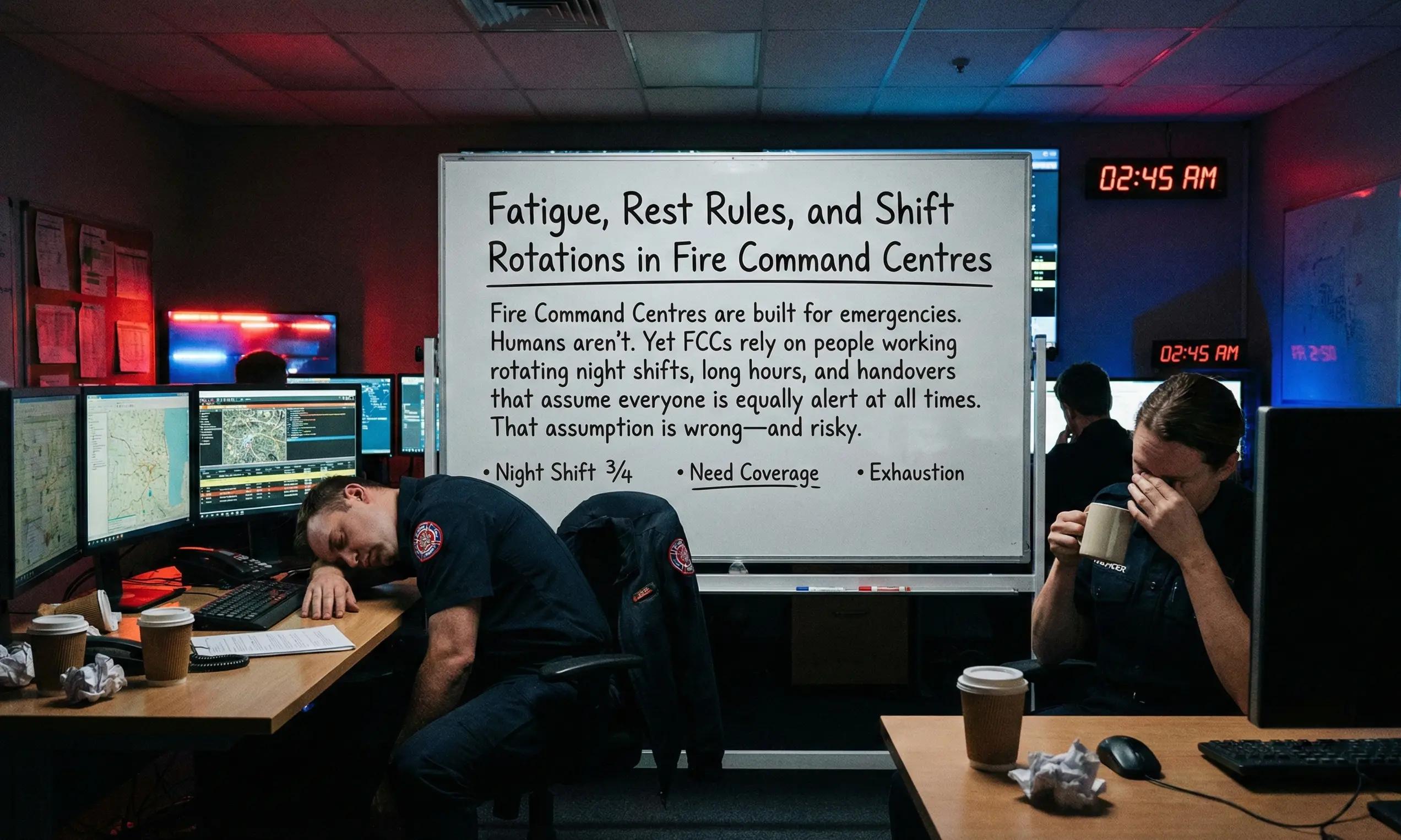
Fatigue, Rest Rules, and Shift Rotations in Fire Command Centres
Fire Command Centres are built for emergencies.
Humans aren’t.
Yet FCCs rely on people working rotating night shifts, long hours, and handovers that assume everyone is equally alert at all times.
That assumption is wrong and risky.
The topic nobody likes to address
Talk privately with facilities or security managers and the same themes come up:
- Night shifts are hard to staff
- Rotations get messy
- People “help out” after short rest
- Fatigue is handled informally
Nothing looks broken on the roster.
The risk doesn’t live on the roster. It lives at 03:30.
Why FCC fatigue is different
FCC roles are not repetitive tasks.
They require:
- constant monitoring
- pattern recognition
- correct decisions under pressure
- precise communication
Fatigue doesn’t just reduce comfort. It reduces situational awareness.
And in an FCC, that’s the job.
Common FCC shift models (and their weak points)
8-hour rotations (3 shifts)
Pros
- shorter shifts
- easier recovery
Cons
- more handovers
- higher coordination risk
Failures usually happen during rushed handovers or night-to-morning transitions.
12-hour rotations (2 shifts)
Pros
- fewer handovers
- simpler staffing
Cons
- cognitive drop late in the shift
- night shifts become punishing
Failures usually happen in hours 10–12 or after consecutive nights.
How rest rules quietly erode
No one plans to break rest rules.
It happens gradually:
- “Just one extra night”
- “Only a short cover”
- “They said they’re fine”
On paper: compliant. In reality: fragile.
After an incident, explanations don’t help.
Why fatigue becomes a compliance issue
During audits or incident reviews, questions don’t stop at coverage.
They extend to:
- fitness for duty
- reasonableness of rotations
- systemic patterns vs one-off events
If you can’t show structure and intent, you’re left explaining behaviour.
Can you see fatigue in your FCC schedule?
Most teams can’t.
Here’s the test:
Can you clearly see consecutive shifts, night stretches, and short rest periods before they become a problem?
If not, fatigue is being managed informally.
What mature FCC operations do differently
They stop treating fatigue as a personal issue.
They treat it as an operational risk.
That means:
- rest-aware scheduling
- guardrails on night-to-morning transitions
- visibility into consecutive shifts
- rotation rules that are enforced, not suggested
- history that shows reasonable decision-making
This protects:
- staff
- management
- the building
Final thought
A Fire Command Centre can be fully staffed and still unsafe.
If 24/7 coverage depends on tired people quietly pushing through, you’re betting on luck.
FCCs exist because luck is not a strategy.
Want to understand your FCC fatigue risk? Run the FCC Readiness Check →